Braces and clear aligners are the two main ways to straighten teeth: braces use brackets and wires adjusted by the orthodontist over time, while aligners are removable transparent trays worn in sequence. Neither is universally better — the right choice depends on your case and lifestyle, which is why a professional evaluation matters.
What orthodontic treatment does
Before comparing the two options, it helps to understand what they are both trying to accomplish. Orthodontic treatment moves teeth through bone into better positions. Teeth are not fused to the jaw; each sits in a socket, held by ligaments, and sustained gentle pressure causes bone to remodel around the tooth — dissolving on the pressure side and rebuilding on the other. Both braces and aligners exploit this same biological process; they differ only in how they deliver the force.
People seek orthodontic treatment for crowded or spaced teeth, overbites, underbites, crossbites, and open bites — conditions that can affect chewing, speech, jaw comfort, and long-term tooth wear, not just appearance. Treatment typically takes many months to a few years depending on complexity, and it concludes with a retention phase (retainers) that holds teeth in their new positions while the surrounding bone stabilizes.
How braces work
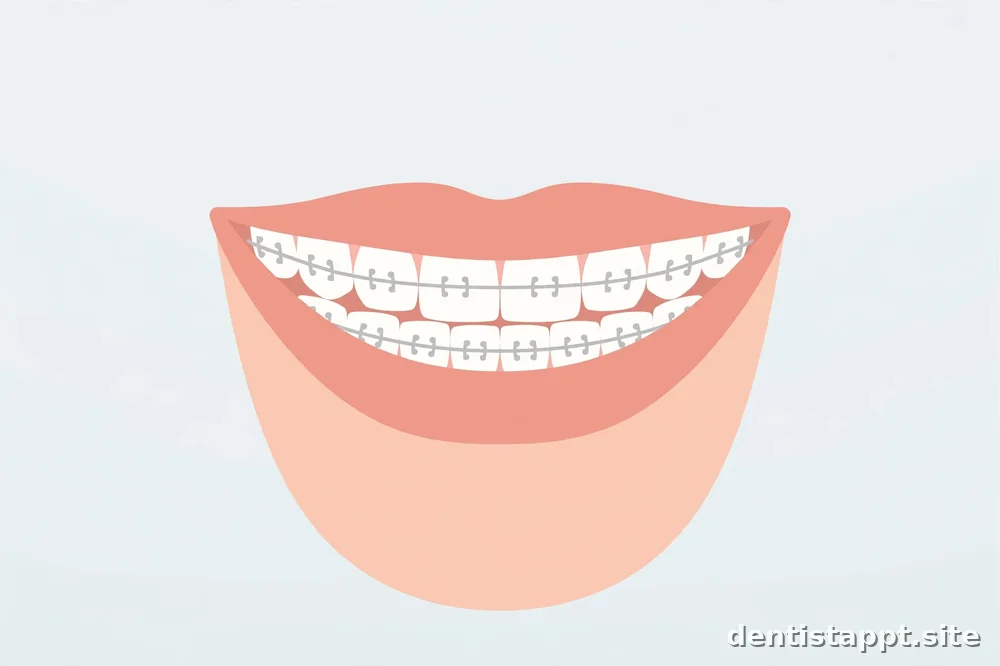
Traditional braces consist of small brackets bonded to the front of each tooth, connected by an archwire that runs through them. The wire, held in place by tiny elastic ties or self-ligating clips, exerts continuous gentle pressure. At adjustment appointments — usually every four to eight weeks — the orthodontist changes or tightens components to progress the treatment plan. Modern brackets are smaller and more comfortable than their predecessors, and ceramic or tooth-colored brackets offer a less conspicuous look than metal.
Variations exist. Lingual braces mount on the tongue side of the teeth, making them essentially invisible from the front, though they can affect speech initially and are more demanding to clean around. Self-ligating braces use a built-in clip instead of elastic ties, which some orthodontists prefer for efficiency. But the core concept is the same across all fixed braces: the appliance stays on your teeth around the clock, working continuously, and only the orthodontist adjusts it.
Because braces are fixed, they work independently of patient compliance with wear time — the appliance cannot be forgotten on a nightstand. The trade-off is that everything about daily life adapts around them: eating, brushing, and flossing all require modified technique for the duration of treatment.
How clear aligners work
Clear aligners take a fundamentally different approach. After digital scans or impressions of your teeth, a series of custom-made transparent plastic trays is produced — each tray slightly different from the last. You wear each set for the prescribed period (commonly one to two weeks), and each successive tray nudges the teeth a fraction further toward the planned positions. Attachments — small tooth-colored shapes bonded to certain teeth — may be used to help the trays grip and direct specific movements.
The defining feature of aligners is removability. You take them out to eat, drink anything other than water, brush, and floss — which means no food restrictions and normal oral hygiene. But removability is also their central vulnerability: aligners only work while worn, and the standard guidance is around twenty to twenty-two hours per day. Every hour they spend in their case instead of your mouth is an hour treatment is not progressing, and inconsistent wear is the most common reason aligner treatment stalls or underperforms.
Treatment is monitored through periodic check-ins — in person or via remote photo submissions, depending on the provider — where progress is compared against the planned tooth movements and the next sets of trays are issued.
Daily life: an honest comparison
The day-to-day experience differs more than the clinical mechanism does, and lifestyle fit is often what drives the decision.
Eating. With braces, certain foods are off the table for the duration: hard foods that can break brackets, sticky foods that pull at wires, and habits like biting ice or chewing pens. Meals require some care — cutting food smaller, chewing deliberately. With aligners, you simply remove the trays and eat normally, then brush before putting them back in. For people unwilling to give up crunchy or chewy foods for a year or more, this is a significant difference.
Hygiene. Brushing and flossing around braces takes longer and requires tools like interdental brushes or floss threaders; food traps easily, and poor hygiene during braces treatment can leave permanent marks on the enamel. Aligner wearers brush and floss normally with the trays out, then clean the trays themselves. From a hygiene standpoint, aligners are generally the easier option — provided the wearer actually brushes before reinserting trays, since trapping sugary residue under a tray against the teeth is a recipe for decay.
Appearance and speech. Clear aligners are the more discreet option by design — most people will not notice them in conversation. Braces are visible, though ceramic brackets reduce the visual impact. Both can cause a brief adjustment period in speech; aligners may cause a slight lisp at first, and lingual braces can affect tongue placement more noticeably. Most people adapt within a week or two.
Comfort. Both cause periodic soreness — after braces adjustments and when starting each new aligner tray — as teeth begin moving. This typically fades within a few days. Braces can also irritate the insides of the cheeks and lips, especially early on; orthodontic wax helps. Aligners can irritate the tongue or gums if a tray edge is rough, which the provider can smooth.
Appointments and lifestyle logistics. Braces require regular in-office adjustment visits. Aligner treatment often involves fewer in-person visits, with progress checks sometimes done remotely — an advantage for people with demanding schedules or limited access to an orthodontist. On the other hand, aligners demand constant personal discipline: trays in for nearly the whole day, removed only for eating and cleaning, never lost, never left behind on a trip.
What each option handles best: the clinical considerations
This is where the comparison gets nuanced, and where professional evaluation is genuinely irreplaceable. As a general concept, fixed braces give the orthodontist direct, continuous mechanical control over each tooth — including complex movements like significant rotations, vertical changes, and large bite corrections. For complex cases, braces are often the more predictable tool.
Clear aligners have expanded enormously in capability and now handle many moderate cases very well. But they remain dependent on wear-time compliance, and certain tooth movements are mechanically harder to achieve with removable trays than with fixed appliances. Your orthodontist evaluates factors like the severity of crowding or bite discrepancy, which specific movements are needed, the condition of your teeth and gums, and your age and growth status — then recommends accordingly.
Be cautious of anyone promising a specific outcome or timeline without examining you. Orthodontic treatment is planned tooth by tooth; two people with "crooked teeth" can have very different treatment needs. A proper evaluation includes X-rays, photographs, and often digital scans — not just a glance.
Cost factors (not prices)
Orthodontic treatment is a significant investment, and total cost varies widely by case complexity, treatment length, geographic area, and provider. Rather than focusing on which option is "cheaper" in the abstract, consider the factors that drive cost: complexity and duration of treatment (longer, harder cases cost more regardless of method), the provider's expertise, what is included (retainers, follow-up visits, refinements), and whether your dental insurance covers any portion of orthodontic care.
Ask for an itemized written estimate that covers the full course of treatment, including retainers and the expected number of refinement stages. Our checklist of questions about dental costs applies to orthodontic consultations just as it does to general dentistry. And remember that the cheapest quote is not automatically the best value — experience with your specific type of case matters enormously in orthodontics.
Working with an orthodontist
Orthodontists are dentists with additional years of specialized training in tooth movement and bite alignment — you can learn more about dental specialties in our guide to the types of dentists. For significant alignment work, consulting an orthodontist (rather than a general provider offering orthodontics as a sideline) is worth considering, particularly for complex cases.
At a consultation, expect a thorough examination and a proposed treatment plan with alternatives. Good questions include: Am I a candidate for both options, or does my case favor one? What would treatment look like month by month? What happens if I do not comply perfectly with aligner wear? What does retention involve afterward? How do you handle refinements if teeth do not track as planned?
When you are ready to move forward, see our guide on how to book a dentist appointment for the practical steps. And if you are thinking about the cosmetic side of your smile more broadly, our overview of teeth whitening options covers what whitening can and cannot do — noting that whitening is generally done after, not during, orthodontic treatment.
FAQs
Are clear aligners as effective as braces?
They can be, for the right cases — but "the right cases" is doing a lot of work in that sentence. Aligners handle mild to moderate crowding, spacing, and many bite issues very well when worn as directed. Complex movements — severe rotations, significant vertical changes, major bite corrections — are often more predictably managed with fixed braces. Effectiveness also depends heavily on compliance: aligners worn eighteen hours a day will underperform braces that work twenty-four. Your orthodontist's assessment of your specific tooth movements is the reliable answer, not a general rule.
How long does orthodontic treatment take?
It varies enormously with case complexity. Mild alignment issues may resolve in under a year; comprehensive treatment commonly runs eighteen months to two years or more; complex surgical-orthodontic cases take longer still. Both braces and aligners work on similar biological timelines — bone remodels at its own pace regardless of the appliance. Be skeptical of anyone promising dramatically faster results without explaining how; accelerated claims deserve scrutiny. After active treatment, retention (wearing retainers) continues long-term to hold the result.
Do braces or aligners hurt?
Both cause intermittent soreness rather than continuous pain. With braces, expect tenderness for a few days after each adjustment; with aligners, each new tray typically causes a day or two of pressure-like soreness as teeth start moving. Cheeks and lips may need time to toughen up around braces brackets. Most patients manage with over-the-counter comfort measures and find the soreness becomes routine background noise within the first month. Sharp or persistent pain is not normal with either option and should be reported.
Can adults get braces or aligners?
Absolutely — a large and growing share of orthodontic patients are adults. The biology of tooth movement works at any age, though treatment in adults can take slightly longer because bone remodeling slows, and adults are more likely to have complicating factors like missing teeth, gum disease history, or existing restorations that the plan must work around. Many adults prefer aligners for discretion or ceramic braces for a subtler look. Age itself is rarely a barrier; overall dental health is what matters.
What happens after treatment — do I need retainers forever?
The retention phase is not optional: without retainers, teeth tend to drift back toward their original positions because the surrounding bone and ligaments need time to stabilize — and even then, natural age-related shifting continues for life. Most orthodontists prescribe full-time retainer wear initially, transitioning to nighttime-only wear long-term. Retainers may be removable trays or thin wires bonded behind the front teeth. Factor retainers and replacement retainers into your planning; they are part of the treatment, not an accessory.
This site is educational information only — not medical advice. Consult a qualified dental professional about your own situation.